
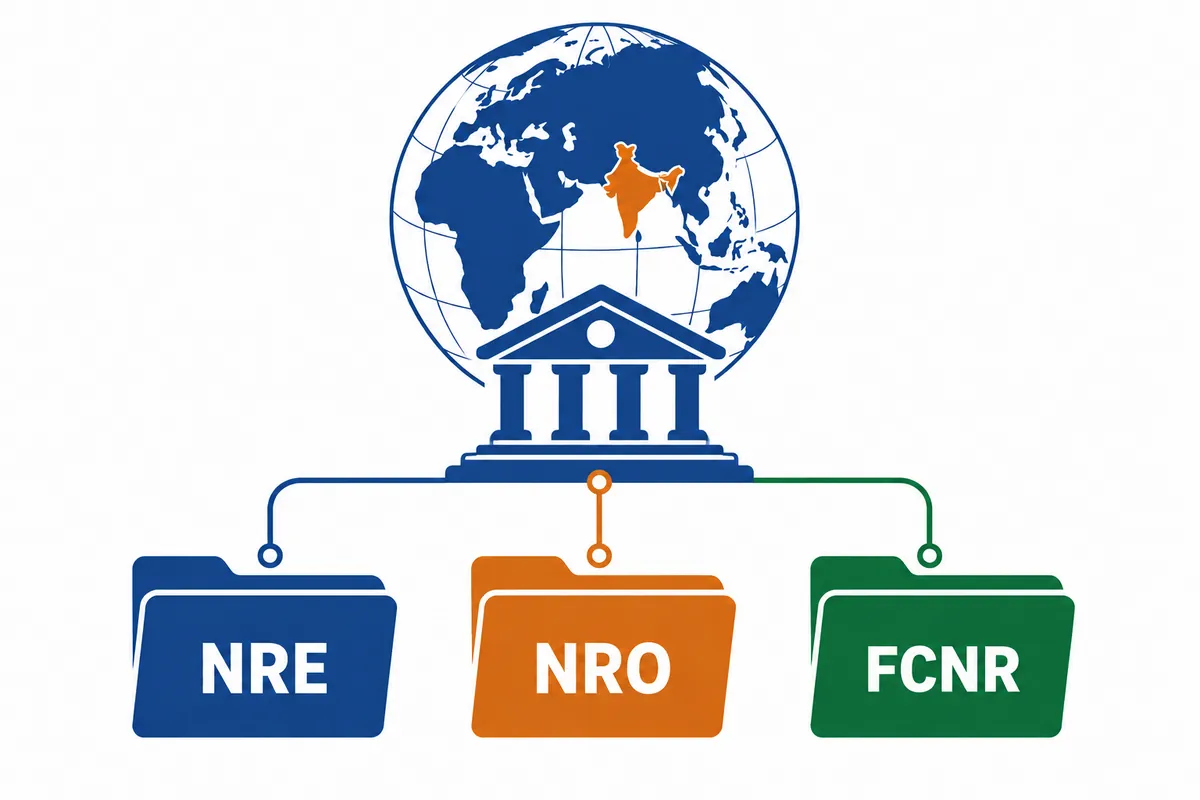
Moving abroad changes how you bank in India. When your FEMA status becomes non-resident, inform your bank. Existing resident accounts must be redesignated as NRO accounts [2].
Eligible NRIs and PIOs can also open NRE and FCNR accounts [2]. Here is how they work.
1. Who counts as an NRI here
An NRI is an Indian citizen resident outside India under FEMA [3]. Eligible PIOs can open these accounts too. The PIO definition includes OCI cardholders [3].
Your income-tax status follows a separate test. Days in India matter, alongside other statutory conditions [5].
Key point: Banking residency and tax residency use separate rules.
2. The three accounts at a glance
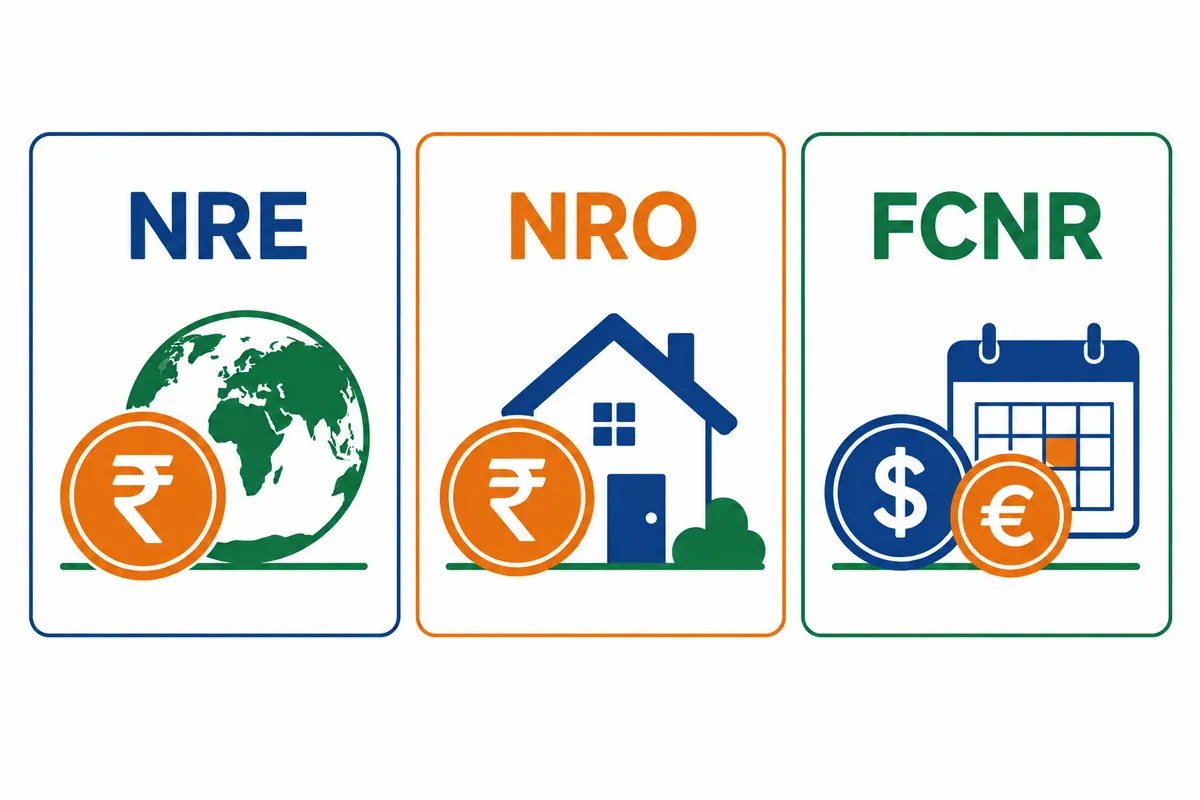
| Feature | NRE | NRO | FCNR |
|---|---|---|---|
| Currency | Indian rupee | Indian rupee | A permitted foreign currency |
| Account types | Savings, current, recurring, fixed deposit | Savings, current, recurring, fixed deposit | Term deposit only |
| Fixed deposit term | 1 to 3 years; banks may accept longer | As applicable to resident deposits | 1 to 5 years |
| Sending money abroad | Principal and interest are repatriable | Current income is permitted. Other eligible funds use the USD 1 million annual facility | Principal and interest are repatriable |
| Interest tax in India | Exempt subject to FEMA or RBI conditions | Taxable | Exempt for eligible non-residents and RNORs |
Table sources: [1], [2], [4], [5] and [6].
The NRO limit is shared across eligible accounts and assets. Tax conditions also apply.
3. NRE account: money from abroad
NRE holds money in rupees. Overseas remittances are permitted [2].
It also accepts certain other credits. Eligible Indian current income can qualify after tax compliance [2].
Joint accounts are allowed with other NRIs or PIOs. A resident relative can join on a former or survivor basis. During your lifetime, that relative needs power of attorney to operate it [2].
NRE generally suits overseas money you may later send back.
4. NRO account: Indian income and money from abroad
NRO holds rupees for legitimate Indian transactions. It can also hold money you send from abroad. Rent and other Indian dues are permitted credits. Local payments are allowed [2].
Joint holders can include other NRIs or PIOs. Resident joint holders are permitted on a former or survivor basis [2].
NRO generally suits Indian income, local payments and money you send from abroad for use in India.
5. FCNR: keeping money in foreign currency
FCNR offers term deposits only. It holds a permitted, freely convertible foreign currency [2][3].
The term runs from 1 to 5 years [1].
Your deposit remains denominated in that foreign currency. A rupee conversion changes the amount received in rupees.
Ask your bank which conversion rate and charges apply.
Tip: Compare conversion costs alongside the deposit terms.
6. How each account is taxed
NRE interest exemption follows FEMA residency or RBI permission. Income-tax non-resident status alone does not determine it [5].
FCNR interest uses a different test. Eligible non-residents and residents who are not ordinarily resident qualify. This latter status is called RNOR [5][6].
NRO interest is taxable. Banks generally deduct 30% under domestic withholding rules. Applicable surcharge increases that tax. A 4% cess applies to tax plus surcharge [7].
Without surcharge, this works out to 31.2%. Treaty relief can reduce withholding where its conditions are met [7][8].
For treaty relief, obtain a valid tax residency certificate. The current information form is Form 41, formerly Form 10F. PAN is optional within Form 41 [8].
Ask your bank for its complete document checklist. Check whether it needs a separate declaration.
Watch out: NRE and FCNR exemptions use different residency tests.
The Income-tax Act, 2025 applies from 1 April 2026. Section and form references have changed. Earlier tax years remain subject to the previous framework [9][10].
Also check your country of residence's tax rules.
7. Moving money back abroad
NRE and FCNR balances are repatriable [1][2].
NRO current income can be remitted after applicable tax compliance. Other eligible balances use the USD 1 million annual facility [2][4].
That ceiling applies per person, per financial year. It covers eligible NRO balances and other eligible asset remittances together. Separate NRO accounts do not create separate limits [4].
The financial year runs from April to March [1]. Transfers from NRO to NRE also use this facility [2].
Key point: More NRO accounts do not increase the annual ceiling.
Ask your bank which remittance documents apply.
Under the current framework, Form 145 replaces Form 15CA. Form 146 replaces Form 15CB. Filing requirements depend on the remittance and applicable exceptions [9].
8. If you return to India

Tell your bank when your FEMA residential status changes.
- NRE: Redesignate as resident, or transfer eligible funds to RFC [2].
- NRO: Redesignate as resident when you return with an intention to stay indefinitely [2].
- FCNR: It may continue until maturity at the contracted rate. At maturity, choose a resident rupee deposit or an eligible RFC account [1].
RFC means Resident Foreign Currency.
Bank account treatment does not settle your tax status. FCNR interest can remain exempt during eligible RNOR status. Ordinary resident status can make that interest taxable [5][6].
Watch out: Continuing a deposit does not guarantee continuing tax exemption.
9. Matching the account to the need
- Overseas money held in rupees: consider the NRE account's features.
- Indian income, local payments and money sent from abroad for use in India: consider the NRO account's features.
- Foreign currency held for a fixed term: consider FCNR.
Your goals, residency and tax position shape the comparison. Check current bank terms before opening an account.
10. Questions to ask your bank
- Which deposit terms and currencies do you offer?
- Which documents do you require for treaty relief?
- Which remittance forms apply to my transfer?
- Which conversion rate and charges will you use?
- What changes when I return to India?
11. Sources
All pages were read on 9 October 2026.
Dates below reflect dates shown by the sources. Undated pages were accessed on that date.
- Reserve Bank of India, Accounts in India by Non-residents, 16 January 2025.
- Reserve Bank of India, Master Direction: Deposits and Accounts, updated 2 September 2026.
- Reserve Bank of India, Foreign Exchange Management (Deposit) Regulations, 2016, amended through 29 June 2026.
- Reserve Bank of India, Foreign Exchange Management (Remittance of Assets) Regulations, 2016, 1 April 2016.
- Income Tax Department, Income-tax Act, 2025, as amended by Finance Act, 2026. See section 6 and Schedule IV, items 1 and 14.
- Income Tax Department, Income-tax Act, 1961, section 10. The conditions in section 10(15)(iv)(fa) are retained through Schedule IV, item 14, of the 2025 Act.
- Income Tax Department, Finance Act, 2026. See First Schedule, Part II, and section 3(16).
- Income Tax Department, Form 41 guidance, undated.
- Income Tax Department, Income Tax Forms FAQs, undated.
- Income Tax Department, Income-tax Act, 2025 commencement release, 1 April 2026; Non-resident transition FAQs, undated.
This article is for education only. It is not investment advice.
Mutual fund investments are subject to market risks. Read all scheme related documents carefully.